
By Phoebe Taber
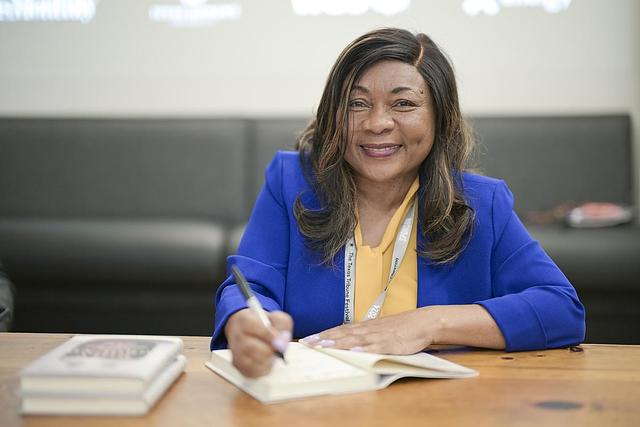
In the Captain America meeting room on the eighth floor of the Omni Hotel, Catherine Coleman Flowers was interviewed by John Schwartz on Saturday, Nov. 15, 2025.
Flowers is an environmental and climate justice activist, founding director of the Center for Rural Enterprise and Environmental Justice (CREEJ), and author of “Holy Ground: On Activism, Environmental Justice and Finding Hope.” She has also been featured on Forbes’ 50 Over 50 list, Time’s 100 Most Influential People of 2023, received the 2025 TIME Earth Award and was named a 2020 MacArthur Fellow.
As an advocate for environmental health, Flowers’ story has been deemed the “Erin Brockovich of sewage.” Similar to Brockovich, an environmental activist who helped build a case against groundwater contamination by Pacific Gas & Electric Co., Flowers started as a citizen concerned for the civil rights of those living in rural communities.
The panel’s topic was supposed to center around Flowers’ recent book, a collection of personal and political essays revolving around climate change, human rights, rural poverty and reproductive justice. Instead, Schwartz and Flowers took the opportunity to focus on unequal sanitation and sewage access in marginalized communities.
Flowers’ story started when she moved to Lowndes County, Alabama. There, she witnessed a majority Black population being disenfranchised by the failure of local sanitation systems. These poorer communities lacked access to functioning septic systems, with Flowers stating, “If you don’t have the tax base, you can’t pay for it.” People were being arrested for not having a functioning septic system, an issue that provoked Flowers to take action.
Flowers soon founded CREEJ, an organization built to combat environmental injustices. Its mission statement is to “[r]educe health and economic disparities and improve access to clean air, water and soil in marginalized rural communities by influencing policy, inspiring innovation, catalyzing relevant research and amplifying the voices of community leaders, all within the context of a changing climate.”
A key focus of Flowers’ panel was that this issue does not only affect people of color. While Lowndes County is predominantly Black, poor sanitation and sewage access affect all people in those communities, with Flowers adding, “It doesn’t harm people based on race.” Anyone near these areas is at risk of disease and harm. “Most of these systems are built to last 25 years, and they’re well past that,” Flowers said. Even if people have access to a septic system, it may still be dysfunctional. She told the story of residents who have to evacuate their homes before storms, fearing “sewage being pushed back into homes.”
Flowers also mentioned the worsening effects of climate change on the issue. Longer and more severe storms bring more water, causing these systems to overflow.
Despite these challenges, Flowers holds on to hope. She believes the next generation holds the answer.
“All of the great ideas have come from young people. The great changes in history have come from young people,” Flowers said. “So my hope, and the reason why I speak to young people, is that they’re the ones who are going to find the solution.”
“They’re not in a box. They think differently than the way we think. Where some of us have been trained a certain way, young people are very different. Just stay focused, they are the hope for the future.”