

By Izzy Cissoko
Continuing its festival circuit, “The Debut” brings a warm and harmonious opening night narrative feature to the 33rd annual Austin Film Festival. The latest project from actor, writer and director Jesse Eisenburg, filled seats at the Hogg Memorial Auditorium on Thursday, Oct. 29.
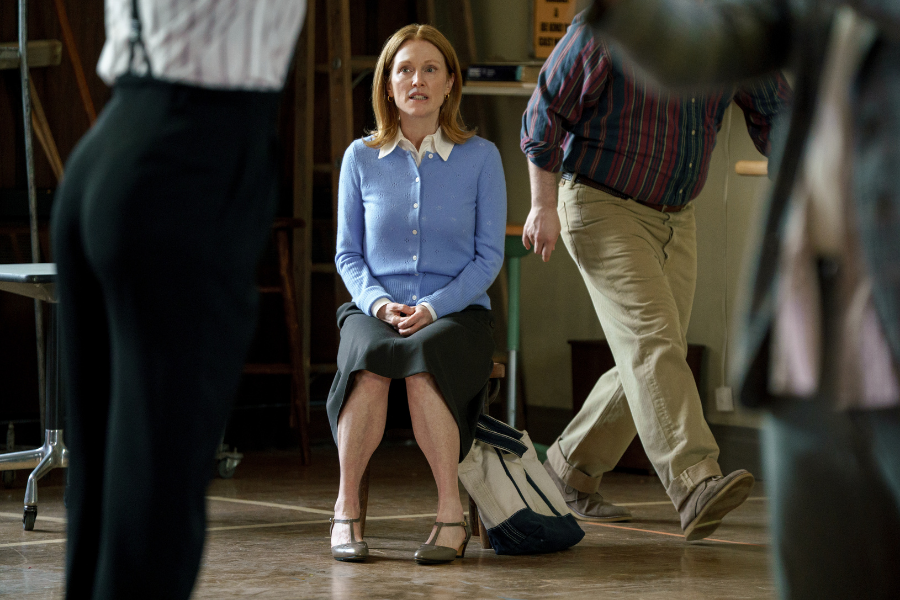
With nostalgic 90s Lynchian lighting, the film opens up to our main protagonist Mona, portrayed by Julianne Moore, quietly sitting at a table in an asian restaurant while she watches her friend spoon-feed a dessert into her husband’s mouth. The absurdly humorous first scene takes the audience by surprise and sets the tone for the rest of the film, letting everyone know they are in for a real treat.
Mona is a woman who, for most of her life, has become accustomed to taking up as little space as possible. A quiet, seemingly unassuming housewife, she exists in the background of her own life, often overlooked by her husband, children, and just about everyone she encounters. That is, until an unexpected opportunity to audition for a small role in a local community theater production sends her down a rather unconventional path of self-discovery.
What begins as a harmless attempt to step outside her comfort zone quickly becomes an all-consuming obsession with her character, Miss Danielle, and the artistic integrity of a production that isn’t nearly as important as Mona believes.
For the next 105 minutes, the auditorium fills with laughter and excitement as our heroine braves her new surroundings, armed with an unlit cigarette and a maintenance worker’s tool belt.
Watching Moore navigate Mona’s transformation is easily one of the film’s greatest pleasures. Moore makes the evolution from a timid, apologetic woman to an unapologetically demanding method actor look almost effortless. There is something particularly impressive about watching an actress so completely surrender herself to a character who is, in turn, discovering an entirely new version of herself. Her physical mannerisms, shifting expressions, and increasingly unpredictable behavior make Mona’s transformation both hilarious and incredibly believable. Moore never loses sight of the woman underneath all the theatrics, even when Mona becomes almost unrecognizable from the person we met in the opening scene. It reminds the audience just how much fun great acting can be.
Paul Giamatti plays Jerry, the demanding and occasionally infuriating director of the community theater production. Giamatti is an absolute delight. His character takes himself, his production, and his artistic vision perhaps a little too seriously, creating a wonderful contrast to the otherwise modest scale of the theater company. Giamatti has a particular talent for making even the most ridiculous dialogue sound completely sincere, and his deadpan delivery is responsible for some of the film’s biggest laughs. Beneath Jerry’s intimidating exterior, however, lies a much more complicated character.
His own relationship with acting, ambition, and the passage of time adds unexpected emotional depth. The chemistry between Giamatti and Moore is especially enjoyable, making their increasingly complicated director and actor relationship one of the film’s strongest elements.
Then, of course, Halle Bailey, who makes a lovely impression as Stef, the production’s leading lady. With an almost angelic presence, Bailey brings a refreshing sweetness to a film largely populated by eccentric personalities and theatrical egos. Although Stef initially appears to be the picture-perfect theater girl, Bailey gives the character enough warmth and personality to make her feel like more than just another face in the ensemble. Her natural charm and musical abilities make her an enjoyable addition to this cast, and her interactions with Mona provide some of the film’s more tender moments.
As a writer, Eisenberg continues to demonstrate an impressive understanding of the awkward, uncomfortable, and often absurd ways people interact. His screenplay finds humor in the self-importance of community theater without ever making the characters feel entirely ridiculous. Instead, he seems genuinely interested in the people who dedicate their time and energy to creating something, regardless of how small the audience might be. There is an underlying affection for the creative process keeping the film from becoming a simple satire of amateur theater. Eisenberg also wrote the original musical numbers featured in the fictional production, ‘Nosy Neighbors’, which are wonderfully cheesy in all the right ways. The songs feel like something you might actually encounter at a local theater production, and their exaggerated theatricality only adds to the film’s charm.
The sound design deserves some recognition of its own. Between the theatrical rehearsals, musical performances, and quieter moments of Mona’s everyday life, the film creates an engaging audio landscape that helps establish its wonderfully unusual atmosphere. The original score by Emile Mosseri complements Eisenberg’s musical numbers particularly well, balancing moments of whimsical theatricality with a slightly more unsettling undertone. The music never feels like an unnecessary distraction; instead, it becomes another way of understanding Mona’s increasingly distorted relationship with the world around her. It is a thoughtful technical contribution that helps bring the film’s eccentric personality together.
What makes “The Debut” particularly enjoyable is that beneath all its absurdity, it has something rather sincere to say about the importance of finding something that makes you feel alive. It is a film about allowing yourself to be seen, embracing the unfamiliar, and occasionally making a complete fool of yourself in pursuit of something you love. While Mona’s transformation takes a few unexpected turns, Eisenberg never loses sight of the heart behind her journey.
My verdict: 4 out of 5 stars.
“The Debut” is a charming, laugh-out-loud theatrical adventure carried by an outstanding performance from Julianne Moore and an equally entertaining supporting cast. It is quirky without being exhausting, heartfelt without becoming overly sentimental, and just strange enough to keep you guessing. If you enjoy character-driven comedies, unconventional coming-of-age stories, or simply watching talented actors have an absolute blast with their material, this one deserves a spot on your watchlist.
Following its festival run, “The Debut” is set to arrive in theaters nationwide on December 11, 2026, courtesy of A24. So grab a friend, find your nearest theater, and give Mona Friedman the audience she has spent her entire life waiting for.