Bring Me Ashore

story by Aaron Moeller, Vice President of NeuroBats of ACCess Autism, ACC GROW associate, Music

illustrations by Danielle Moak, President of NeuroBats of ACCess Autism, ACC GROW associate, Game Art

Content warning: Mentions of self- injurious behavior and sexual assault.
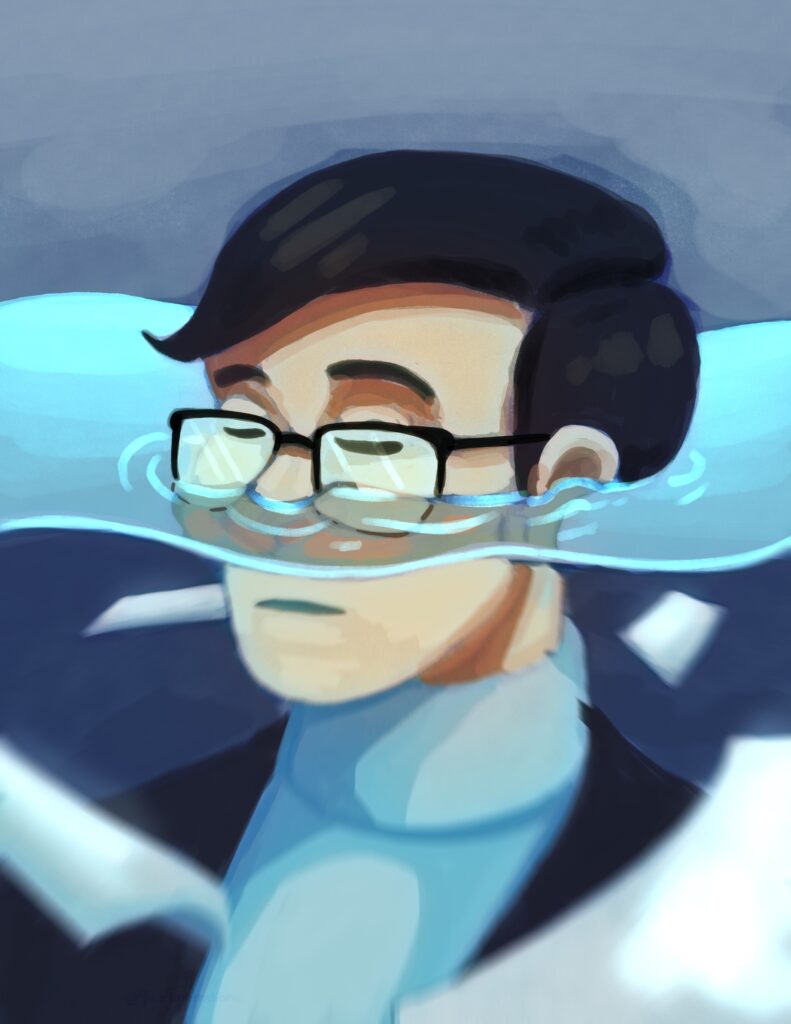
Digital illustration of an individual under water with half of their head above it. As if they will soon be consumed by the water. There are objects that look like falling paper in the water.
“Drowning in Overwhelming” by Danielle Moak

Many times, I feel as if I am a fish without a school and lost at sea. 

Around me are sharks of every shape. The world abroad has people who can do amazing things. In my community, there are other fish like me. We recognize each other, listen, and lift each other up. The entire world should learn a lesson from our community; we are all equal, and everyone deserves to be seen. 

When I leave my community and venture out into the world, I experience a different feeling. I can sense the phoniness and the competition permeating everything. It reminds me of sharks fighting over the last fish carcass. Being in the world and disconnected from my community makes me never want to leave them. In our own spaces, we use our voices to ensure that everyone around us is heard. My college’s leadership had recognized me in the past and given me opportunities I will never forget; however, that changed when a wave came in and pulled me out to sea and away from my institution. 

Last year, I submitted a proposal to talk at SXSW EDU, an international convention. This was the first time I would ever do something like this. My talk would be about how it feels to be an autistic student. I also talk about the abuse and trauma I have experienced in my life but also how I was able to triumph over it all. This was one of the most fulfilling experiences I have ever had; having my peers stand beside me and those who attended my presentation saved me from intrusive thoughts that “nobody would care.” 

I was proud that I was the only student at my college to get accepted. I prepared for over a year for this presentation, and I allowed myself to completely unmask and divulge my autism so that the audience could understand, to the best of their ability, how it feels to be autistic in a world that feels like it is not made for me. 

After I finished the presentation, I was elated; I had accomplished the impossible, at least impossible to myself. I never believed I had a voice that could reach others and propel institutional change. I was always told that autism did not exist, that it was an excuse to be lazy, and that nobody cared, but I proved everyone who told me that wrong. 

Digital illustration of a an individual kneeling with their hands on their head in frustration. On the floor are pieces of paper with streaks of bright red. Three pieces of paper in the foreground read "Make" "It" "Stop"
“Make It Stop” by Danielle Moak

However, after I gave this presentation, my entire world crumbled. I began having intense flashbacks from my past. I had never spoken about such personal and secret parts of my past to such a large group of people, which included me being sexually assaulted, having to learn how to mask to survive, and how writing became an outlet for me to use my voice in advocacy. 

It felt like my entire mind became an ocean, and I was lost at sea. I desperately needed to get ashore but did not know how to ask for help. I would look around and see everyone around me, but my world felt like an underwater volcano about to erupt, one nobody could see coming. I screamed internally, waiting for someone to hear me. 

I would look online for some closure. Someone there may acknowledge what I have done. My entire life, I have wanted to build and create something—something that can withstand time and create a legacy for me, one that helps other autistic students after me. That is why I did that presentation: to let other autistic and neurodivergent people know that they have a voice, too. 

My brain told me, “Nobody cares about what you did; it is worthless, and you made a fool of yourself.” It told me this for weeks.

A month passed, and now, my favorite month, Autism Acceptance Month, was upon me. April is very special to my friends and I. It reminds us that we deserve to be recognized and that we are humans who also deserve respect and understanding. I could not get myself to smile, though, and I faded into bleak silence as I sunk deeper into my depression. 

“Everyone forgot about your accomplishments; they are not even that good. Get over yourself. Nobody cares,” my brain would tell itself. 

I would search online to see if my institution had posted about my presentation, but I did not see it. I desperately kept refreshing the webpage to see if they would acknowledge me, not just an autistic student, but a non-binary, gay, first-generation Hispanic student who vulnerably put themself out there to educate others on my experience being autistic in college and what support our institution offers. Yet, with every click of the mouse, there was nothing. I then waited to see if my institution would recognize Autism Acceptance Month, but they did not. 

I began to sink even deeper. I lost sight of who I was and why I was alive. Why should I live in a world that does not recognize me or the pain I go through? I did not want to withstand it anymore. I did not want to live. 

I could not handle the noise inside of my head. It felt like a thousand knives were scraping my bones, and I was grasping at them, but every time I lunged, the knives cut deeper. I convinced myself that I would never succeed and be recognized no matter what I did. I would never be like other students who are “good enough” to be on the front page of my institution’s social media accounts. What did I do or say that was so wrong? Is it because I am autistic? 

I screamed and pulled my hair out while I tried to understand what was happening. I just wanted the pain, noise, and intrusive thoughts to end. Was it true that nobody cared about my accomplishments? Probably not, but that did not matter. When my college fears acknowledging me, I feel disconnected from the institution I love. If my brain tells me I will never end up like those successful students on the front page, what evidence do I have to refute that? My mind may be correct. Maybe I am not meant to do great things, and perhaps I am meant to wallow in filth until I die. 

I went to work and saw my friends again after some time. I saw my Transformation Coach and everyone who has always stood beside me. I looked at them all and told them I loved our community; they did not know I had already given up. 

I looked at all of them from head to toe. I noticed their clothes, their faces, and how they smiled at me when I met them in the eye. 

They are my support group. 

I was asked to think about why I do advocacy work. Seeing them reminded me that we do this for the greater good, for others like us who may not be as privileged. 

I have a community, yet I cannot forget the feeling deep inside me, one that my intrusive thoughts were trying to surface. That we are not worth acknowledging. 

Why is it so important that my neurodivergent community and I are acknowledged for our work? If my institution acknowledges us, it gives the greater internal and external community hope that this is where anyone can find a sense of belonging. 

My community may not be what everyone defines as “perfect.” My friends may not be enough for my institution to acknowledge publicly and consistently, but I can accept them just as they recognize me. I can continue using my voice to lift my community just as they lift me.

In the end, the feeling of isolation may never fade. Why are we not good enough to be acknowledged? Why are our accomplishments, the trials we have overextended ourselves to achieve, not presentable? 

I began remembering everything our community has created to highlight autistic and neurodivergent voices, including our artwork, newsletters, presentations, and more. It made me realize I was being noticed the entire time—by those who matter the most. 

Digital illustration of a small boat in the vast ocean. There is an individual on the boat pulling an individual from the ocean. A bright sunset lights the scene, illuminating feelings of hope.
“Bring Me Ashore” by Danielle Moak

At that moment, I was no longer lost at sea; I was pulled ashore. My community and Transformation Coach held me up even though I could not breathe. They held me together when my institution’s fishing lure tangled me. They helped me stay calm when there were only sharks circling me. 

They knew the exact words and when to say them; I did not need to beg them for it. That is what I wish my institution did for autistic and neurodivergent students: not acknowledge us because we are neurodivergent but because we are human, too. In the vast ocean of people, there is room for each color to swim. Will others notice and bring us to shore, or will we be lost at sea?

This article was last updated on 10/16/2024: The caption for the first photo was revised from “Drowning in Overwhem” to “Drowning in Overwhelming. Please note the online copy reflects the update, earlier printed copies may not.
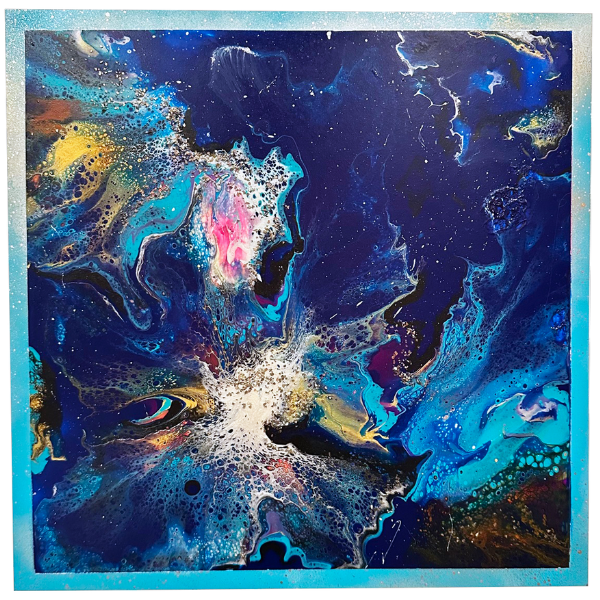

!You Are My Wild Universe!

Abstract painting by Elisha Mac Gregor created with acrylic, spray paint, rocks, and glitter.
You Are My Wild Universe, painting by Elisha Mac Gregor

Artwork and reflection by Elisha Mac Gregor, Psychology, Highland and Elgin Campuses

Have you ever had a moment when you felt a profound sense of wonder and realized that you are part of something much larger than yourself, while looking at the constellations?

This exquisite masterpiece captures the essence of the wild universe stretching across the canvas of your imagination. Each splatter tells a story of creation and chaos of nebules, birthing stars, and black holes. Such a painting is not just a visual presentation; it’s a reflection of the human soul and a metaphorical journey through our collective hunger, spirituality, and quest for knowledge.

Hunger symbolizes our innate desire to explore and understand the galaxy, a starvation that goes beyond the physical. Furthermore, the rocks and colors represent something divine in perfect harmony with the solar system, and the moment when we sense spiritual connection with creation. Lastly, the quest for knowledge represents our attempts to uncover the wild secrets of existence through our scientific explorations, reminding us that there is so much to explore and learn from this macrocosm.

You Are My Wild Universe painting took almost 3 years to master the hair dryer technique which used no brushes. The work on the piece took 35 hours and the materials used are acrylic, spray paint, rocks, and glitter.

Hierarchy of Hunger

Graphic displaying the word hunger five times to fill the shape of a pyramid.
Illustration by Samantha Diwa

by Hamilton Stewart, Journalism, Distance Learning

The brain signals the body that it needs sustenance, and the state of hunger focuses the entire system on finding food in that environment. Human intelligence itself evolved because hunger made early hominids more effective hunters and gatherers. The old adage goes, empty stomachs are often wiser than empty heads. Hunger is wise.

Hunger is a noun, defined as “a feeling of discomfort or weakness, coupled with the desire to eat (“Hunger,” 2024). It is a sensation caused by insufficient consumption of dietary energy. It is a basic need that must be addressed. The body must consume nutrients to grow and sustain life. Hunger is suffering.

Hunger is also a verb, defined as “having a strong desire or craving for” (“Hunger,” 2024). There is no hunger pang. There is no feeling of discomfort or weakness. There is no physiological need. It is a feeling, but it is one of yearning and longing for something. More than an involuntary stimulation to nourish the body, there is an existential need to nourish the mind and soul. Hunger is a struggle.

Abraham Maslow first introduced the concept of a hierarchy of needs in a 1943 paper, titled “A Theory of Human Motivation.” Presented as a pyramid, there are five different levels of Maslow’s hierarchy of needs, starting at the lowest level known as physiological needs. Basic requirements are shelter, clothing, temperature regulation, sex, air, and nutrition (Maslow, 1943). Hunger is human.

Malnourishment, famine, and food insecurity are types of hunger that belong on the basic level of Maslow’s hierarchy of needs. Much like an individual, a society cannot move on to the other levels of more advanced needs until the basic needs are met. Food insecurity has reached unprecedented levels globally. In recent years, the lingering impacts of the COVID-19 pandemic, recurrent droughts, and severe weather events like flooding have driven the increase in global hunger. These factors often compound and contribute to the worsening of food insecurity worldwide (Omer, 2024). Hunger is thriving.

Progressing through Maslow’s pyramid, the second level, known as security and safety needs, refers to financial security, health, wellness, and protection from accidents or injuries. Finding a job, living in a safe neighborhood, contributing to a savings account, and obtaining health insurance are all examples of actions motivated by security and safety needs. The safety and physiological levels combined make up what are considered basic needs. These basic needs are vital to survival and Maslow believed that these needs are similar to instincts and play a major role in motivating behavior. The hierarchy theorizes that people are motivated to fulfill basic needs before moving on to other, more advanced needs. Hunger is a catalyst.

Social, esteem, and self-actualization needs make up the remaining levels of the pyramid consisting of advanced needs. Socially, we need love, acceptance, and belonging. For our self-esteem we need appreciation and respect. Self-actualizing people are concerned with personal growth and achieving their potential. Hunger is transcendent.

Perhaps conflict theory best explains food insecurity (Coser, 1956). Conflict is the main driver of hunger in most of the world’s food crises. Conflict breeds hunger. Conflicts in Syria, Gaza, and Ukraine can disrupt markets, driving up prices, and damaging livelihoods. It can displace farmers and destroy agricultural assets and food stocks. Displacement is both a driver and a consequence of food insecurity. When people are displaced, they can lose access to essential resources like food, clean water, and healthcare and become more vulnerable to malnutrition and hunger. Hunger is well-traveled.

The United Nations Sustainable Development Goal 2 is to end hunger by 2030. Ongoing conflict, the impacts of the COVID-19 pandemic, and extreme weather events have intensified existing inequalities globally, making this goal even more challenging. Today, more people are hungry than at any other point in human history. They are concentrated in the developing world, and their hunger has been exacerbated by several factors related to conflict theory. Over 800 million people, or 10% of the world’s population, go to bed hungry (FAO, et al. 2023.) Hunger never sleeps.

In the United States, however, what strikes us is not hunger, but obesity. According to a recent World Health Organization (WHO) study, more than 1.6 billion people globally are overweight or obese. This epidemic is not limited to America and Western Europe. It is visible in Central and South America, South Africa, and East Asia. In China, the prevalence of childhood obesity rose from 1.5% to 12.6% in eight years. In South Africa, 30.5% of black women are obese (FAO, et al., 2023). Hunger is confusing.

Escalating global hunger and obesity levels might seem like a contradiction, but it is part of a single global food crisis, with environmental, economic, and geopolitical factors. It is perhaps the most glaring way in which global inequality is evident. For most of history, humans hunted or grew food for their own consumption and traveled only short distances from source to stomach. Today, production is concentrated in parts of the world where transportation, refrigeration, and fertilization escalated and became more globally connected and energy-intensive than ever before. Well before the 1970s oil crisis and current biofuel controversy, food and energy systems have been inseparable. This system created a sustained caloric rift dividing western Europe and North America from much of the rest of the world. The combination of energy-intense agriculture and distribution with globalized asymmetry of consumption patterns made food crises on a global scale possible. Hunger is calculated.

Perhaps the old axiom holds that society is a mass of people who get hungry at the same time. The question is, hungry for what? On the developed side of the caloric rift, fat is accumulating at a startling rate. On the developing side, huge populations are increasingly vulnerable to famine and hunger. In 2024, we live in a world divided into fat and hungry zones. People who live in the hungry zones are hungry in the most fundamental sense of the word. Those fortunate enough to live in the fat zones are hungry for the advanced levels of Maslow’s hierarchy of needs. These are fat zone problems. Hunger is biased.

Once the needs at the bottom three levels of Maslow’s hierarchy have been satisfied, the esteem needs begin to play a more prominent role in motivating our behavior to acquire the respect and appreciation of our peers. This is about needing to accomplish things, having our efforts recognized, and contributing to the world. Together, the social and esteem levels make up what is known as the psychological needs of the hierarchy. Hunger is mental.

The top level of Maslow’s hierarchy is the self-actualization needs. In short, it is about achieving one’s full potential. Once we fat zoners are comfortable enough that our survival is assured and we can focus our bandwidth on existential crises, we pursue the need to self-actualize. As Maslow put it, “What a man can be, he must be.” Hunger is subjective.

People today living in hungry zones around the world know true hunger. The physical kind. The kind that hurts. The kind that is ever present develops its personality and shapes the way a person makes decisions by conditioning them to operate from a mindset of scarcity. The hungry zoners have what Maslow (1943) calls deficiency needs which arise from deprivation. Satisfying these lower-level needs is important to avoid unpleasant feelings or consequences. Hunger is denial.

Fat zoners have growth needs. A mindset of abundance allows for these so-called needs. These are the advanced needs at the top of Maslow’s pyramid. These needs don’t stem from a lack of something, but a desire to grow as a person. Hunger is desire.

As Europeans colonized the world and built food systems that underpinned their industrialization and development, they embedded dietary inequality within these systems. The global food crisis is a product of these past practices. One of the greatest challenges of the twenty-first century, then, is to find a way of overcoming this history and producing a more equitable global food system, one in which the fat zoners lose some weight and the hungry zoners gain some. Hunger is balance. Hunger is equity. Hunger is a hierarchy.

Works Cited

Coser, L. A. (1956). The Functions of Social Conflict. New York Free Press.

FAO, IFAD, UNICEF, WFP and WHO. (2023). The State of Food Security and Nutrition in the World 2023. Urbanization, agrifood systems transformation and healthy diets across the rural-urban continuum. Rome, FAO. https://doi.org/10.4060/cc3017en

“Hunger.” Oxford English Dictionary. Oxford University Press, Retrieved March 10, 2024. https://www.oed.com/dictionary/hunger_n?tab=factsheet#1153877.

Maslow, A.H. (1943). “A Theory of Human Motivation.” Psychological Review.

Omer, S. (2024). Global Hunger: 7 Facts You Need to Know.” World Vision. https://www.worldvision.org/hunger-news-stories/world-hunger-facts.