Student’s bee business reaps mental health benefits
photos and video reflection by Herber Garcia
Herber Garcia is a Radio-TV-Film student whose experiences with nature have motivated him as a student and as a beekeeper. In the short video below, Herber encourages viewers to explore and pursue their passions to improve their mental health.
Hello Everyone. Today, I am going to be talking about the importance of mental health and how finding a hobby or project can help you. I will be talking about my personal experience with my beekeeping journey and how that has influenced me with my mental health.
Pre-Beekeeping, I would struggle with my self-esteem, and I would constantly have voices in my head that aggressively talked down to me, convincing me that I was worth little to nothing. This was mentally unhealthy and is problematic for anyone who believes that they’re worthless because this will actively kill your motivation to improve yourself or your commitment to anything.
Throughout my whole life, I’ve had a passion for nature. Honestly, the whole Animalia and plantae world is truly fascinating with their incredibly diverse creatures that are beautifully designed, roaming around amongst us. When I found out about beekeeping, it hooked my attention because I learned that I could do something I love, help the environment, and occasionally profit from the beekeeping sales or services. Beekeeping seemed perfect for me.
This new discovery of the potential beekeeping hobby gave me the drive and motivation to learn, improve, and sharpen my knowledge of beekeeping. With time, I became a beekeeper. Becoming a beekeeper was an accomplishment, a true achievement that suppressed my harmful thoughts and gave me a sense of fulfillment, knowing that I discovered a true piece of myself.
Which is why I strongly encourage everyone who comes across this to search and explore hobbies. Be able to learn about yourself, be able to discover a passion, and give yourself a want or a reason to push yourself to improve. Thus doing so will improve your mental health.
You Are My Wild Universe, painting by Elisha Mac Gregor
Artwork and reflection by Elisha Mac Gregor, Psychology, Highland and Elgin Campuses
Have you ever had a moment when you felt a profound sense of wonder and realized that you are part of something much larger than yourself, while looking at the constellations?
This exquisite masterpiece captures the essence of the wild universe stretching across the canvas of your imagination. Each splatter tells a story of creation and chaos of nebules, birthing stars, and black holes. Such a painting is not just a visual presentation; it’s a reflection of the human soul and a metaphorical journey through our collective hunger, spirituality, and quest for knowledge.
Hunger symbolizes our innate desire to explore and understand the galaxy, a starvation that goes beyond the physical. Furthermore, the rocks and colors represent something divine in perfect harmony with the solar system, and the moment when we sense spiritual connection with creation. Lastly, the quest for knowledge represents our attempts to uncover the wild secrets of existence through our scientific explorations, reminding us that there is so much to explore and learn from this macrocosm.
You Are My Wild Universe painting took almost 3 years to master the hair dryer technique which used no brushes. The work on the piece took 35 hours and the materials used are acrylic, spray paint, rocks, and glitter.
by LaKisha Barrett, PhD, Associate Professor & Associate Dean of Purpose & Belonging, Highland Campus
In its most basic form, hunger is an emphatic drive that compels us to seek sustenance for our physical well-being. This human need, deeply ingrained in our biology, ensures our survival and transformation. This transformation is at the cellular level, converting food to chemical energy to fuel our cells and growth. Our whole being (cells to organs) needs the nourishment.
Extending this concept to academia, we encounter a similar life-sustaining craving: academic hunger. This is an intense desire for educational success and personal growth to transform the future. This hunger is resounding and often untapped among students who are underserved, underprepared, underinspired, and overburdened by the strains of life. Academic hunger is about more than just the quest for grades or degrees. It is a deep yearning for empowerment and self-improvement, a drive to overcome obstacles and achieve personal goals. For students facing significant barriers, academic hunger becomes a manifestation of resilience, a determination to find inspiration amidst challenges, and a commitment to turning aspirations into reality- transforming generations to come.
However, it’s crucial to recognize that real hunger—physical, emotional, and psychological needs—must be addressed for academic hunger to be fully realized. According to Maslow’s hierarchy of needs, basic physiological and safety needs must be met before pursuing higher-level goals such as esteem and self-actualization, which are vital for academic success. Students struggling with food insecurity, financial instability, or lack of emotional support may find it challenging to focus on their studies and fully engage in their academic pursuits.
Therefore, fostering a sense of community and providing access to resources is paramount for raising awareness of and nurturing academic hunger. When students feel connected to a supportive community and have their basic needs met, they are better equipped to focus on their academic and life goals. This includes access to food, safe housing, financial aid, mental health support, and a sense of belonging and identity within the academic community. Belonging is the foundation of success- when students don’t feel othered due to a lack of knowledge, resources, and opportunities, they begin to blossom. Belonging transforms and fuels academic hunger into a sense of purpose, leading to increased retention, persistence, and, ultimately, lifelong learning and success. The journey through academia, especially for those from marginalized backgrounds, often feels like navigating a vast, uncharted territory with few familiar faces, stories, educational norms and expectations, and career possibilities. The hunger for academic success is not just about acquiring knowledge; it’s about seeing ourselves reflected in that knowledge, feeling a sense of belonging in the discipline, and being affirmed to bring their authentic selves to their career.
Inclusive educational environments where students see themselves reflected in their course materials, hear diverse voices in their lectures, and encounter role models who mirror their own experiences strengthen their sense of belonging. This representation is not just about visibility; it’s about validating the aspirations and struggles of students from all walks of life.
For students battling against the odds, academic hunger manifests as a resilience to push through and past obstacles and a determination to find inspiration in unlikely places. It is about committing to the journey of transforming aspirations into tangible achievements. However, the path to nurturing this hunger is not a solitary one. It requires a supportive ecosystem that acknowledges each student’s unique strengths and struggles and provides the necessary resources, affirmation, and encouragement to keep their hunger for learning alive. This hunger continues to fuel my journey and transformation.
I Toil, by LaKisha Barrett, PhD
I speak in dreams, I speak of hopes, I speak of change, I speak because I can.
I toil because the seeds of change need tending, water, and positive intent.
I transfer energy because it was transferred to me.
I rejoice in other’s successes because I flourish when I feel the inspiration and manifestation of our collective dreams.
by Christopher Rzigalinski, Managing Editor, Riverside Campus
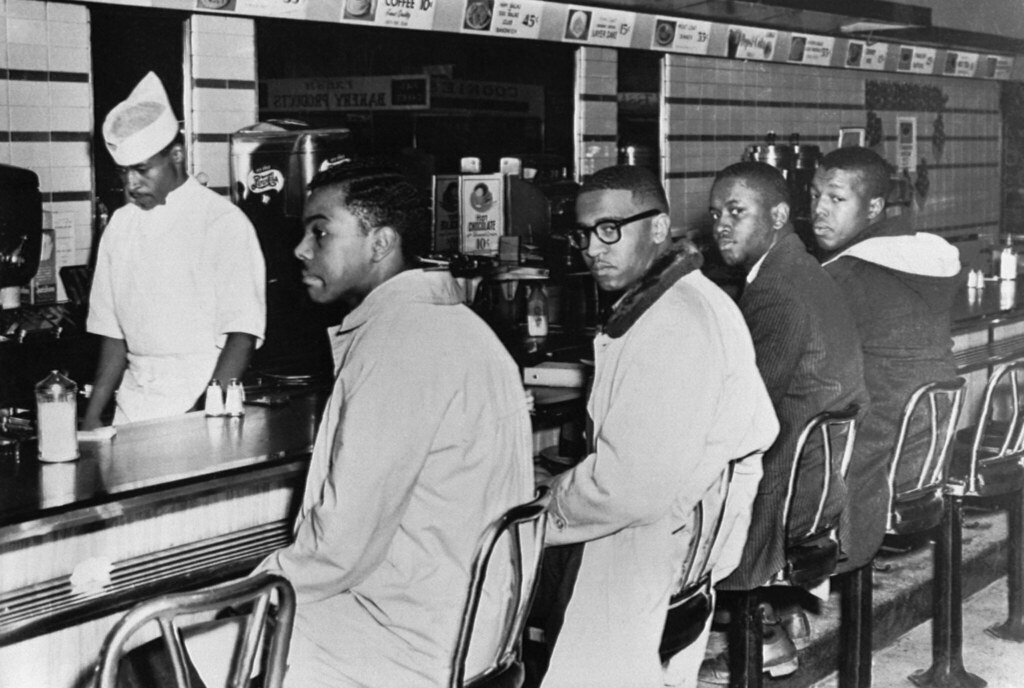
April 29, 2024 marks the 64th anniversary of Austin’s first large-scale lunch counter sit-ins to protest segregated restaurants. The actions were Austin’s entry into a progressive civil rights strategy of passive resistance that began in earnest on February 1 of that year, after a group of African American students sat-in at a Greensboro, North Carolina Woolworth’s counter (History.com Editors, 2022).
Similar demonstrations were staged across the country, resulting in protesters being arrested for trespassing, beaten, and, in some cases, murdered. Their sacrifices led to the re-examination of segregationist service policies and, by extension, a critique of institutional racism in the United States. Hunger served as a pivotal symbol by both mirroring the biological sameness of all human beings and acting as an alarm to signal social inequities.
Food is central to understanding the African diasporic experience in the United States. Culinary historian and James Beard Lifetime Award Winner Jessica B. Harris argues that Texas occupied a complex space for enslaved people in the 19th Century as both a gateway to freedom and as a multicultural intersection. In High on the Hog: A Culinary Journey from Africa to America, Harris notes that enslaved people from Africa were forced into the territory of New Spain by Europeans as early as 1528, cross-culturally shaping the region by synthesizing their traditional recipes with those of Spanish and Native American cuisines (Harris, 2011). These practices continued for nearly three hundred years until enslaved peoples were freed under Mexican independence in 1821. This mélange inspired those who felt marginalized on the East Coast.
The third annual Convention for the Improvement of the Free People of Color (“News from Texas”) was held in Philadelphia, Pennsylvania in 1833. Debate about how to escape from racist oppression led to a vote for mass immigration to Texas (Harris, 2011). From afar, Texas appeared to be a refuge. However, tensions between Tejanos and the Mexican government were on the eve of erupting into another revolution. When Texas became an independent republic in 1836, its government reinstated slavery laws. By 1845 it was annexed to the United States as a slave state. The Civil War broke out shortly thereafter in 1861, leading to a Texan alignment with the Confederacy.
When Major General Gordon Granger of the Union Army ordered the final enslaved Texans freed on June 19, 1865, two years after the Emancipation Proclamation was issued, African American cuisine took on a new importance. Jessica Harris reflects:
[T]he backbone of Juneteenth celebrations had always been the table. In the early years, those who had toiled in sorrow’s kitchen commemorated their liberty with some serious eating. Picnics and barbecues were the hallmarks of the early celebrations, and groaning boards covered with bright cloths offered specialities like barbecued ribs and fried chicken and myriad variations on summer produce like black-eyed peas, peaches, and watermelon (Harris, 2011).
In a society of oppression, sharing food was a subversive act that expressed hard-won freedom.
Laws enforcing segregation at the state and local levels took hold following the Civil War. Reconstruction, the Federal Government’s attempt to rebuild Southern states by creating employment, land cultivation, and political office opportunities for those who were formerly enslaved, fizzled by 1877. President Andrew Johnson, Abraham Lincoln’s successor, and other conservative Southern Democrats stymied progress by calling for the return of land to its original owners and arguing that state governments should be in charge of their own rebuilding (Manevitz, 2020). The resulting “Jim Crow” laws enforced segregationist policies through the division of public spaces like water fountains, movie theaters, and restaurants.
Almost one hundred years later, the Greensboro Four challenged the separation of public spaces in 1960. Ezell Blair Jr., David Richmond, Franklin McCain, and Joseph McNeil, young Black men studying at North Carolina’s Agriculture and Technical College, took seats at their local Woolworth’s lunch counter and asked to be served. The request sent shock waves through America and reinvigorated the civil rights movement. Moreover, it illustrated the power of student voices to challenge a broken system. Protests sprang up across the South, including Texas. San Antonio became the first major Southern city to integrate its lunch counters on March 16, 1960 (“San Antonio Woolworth’s Building,” 2020).
To get ahead of any conflicts in the state’s capitol, a conference was arranged by the Austin Commission on Human Relations and held in a meeting room at the Austin National Bank. African American community leaders from East Austin and a delegation of students met with operators of downtown cafeterias, cafes, and lunch counters. Reverend Brandoch Lovely of the Austin Unitarian Church served as the spokesperson for the community and student leaders. He was quoted in the Austin Statesman on April 20, 1960, saying he hoped for a “‘peaceable adjustment’” (Weddell, Jr., 1960). Lovely went on to say, “‘There is a necessity for both sides to act with responsibility,…Negro students have shown a willingness to negotiate, and I hope the restaurant operators will adopt the same attitude’” (Weddell, Jr., 1960).
Austin Bureau of the News journalist Richard Morehead reported an update on April 29. “Congress Avenue, the capital’s main business district, was picketed Wednesday by students urging integration of lunch counters,” (Morehead, 1960) he noted. “The demonstrators indicated they plan to stage sitdowns by Saturday unless segregation is dropped in downtown eating places” (Morehead, 1960). The threat prompted businesses in major areas like those on the corner of Sixth and Congress to close their soda fountains, fixtures of mid-century drug stores and eateries. Other establishments put chains on their doors and only let in white customers.
Moorehead’s article also revealed that the protesters were multiracial and of mixed genders. “White and Negro students–both male and female–participated in the picketing on both sides of Congress Avenue from Sixth Street to Eleventh, [the] edge of the State Capitol Grounds” (Morehead, 1960). In total, over 200 picketing students came from the University of Texas-Austin, St. Edward’s University, Huston-Tillotson University, and local theological seminaries. Without resolution that day, approximately 100 students occupied seven lunch counters across the aforementioned area, peacefully requesting that Black patrons be served the same as white ones.
Surprisingly, little information exists about the sit-ins in city archives like those of the Briscoe Center for American History at UT-Austin and the Austin History Center. However, a wealth of coverage was devoted to their aftermaths. State legislatures took aim. On March 10, 1961, the Austin Statesman reported on HB 797, a bill making it “unlawful ‘for any person or group of persons’ to enter a privately owned commercial enterprise and remain there after being requested to leave, ‘or after it appears unequivocally that the presence of such person or group of persons is undesirable and unwanted by the owner or management of such enterprise’” (Capitol Staff, 1961). Ironically, the article also specified that the bill’s text noted that “provisions are to be applied ‘without regard whatsoever to race, color, or creed…’” (Capitol Staff, 1961).
Christopher W. Schmidt argues that the nationwide sit-in movement made such an impact because of its innovation. “[Students] were not simply joining a battle that the older generation of civil rights activists were already waging,” (Schmidt, 2017) he writes. “They were striking out on their own, finding new points of vulnerability in the edifice of Jim Crow and locating new targets that resonated with their particular concerns and that aligned with their particular sources of strength” (Schmidt, 2017). Sit-in protesters altered the direction of the movement by putting their bodies on the line to expose the inhumane gesture of denying any person sustenance.
Diorama of student protesters staging a sit-in for lunch counter integration in the early 1960s, part of the “Standing Up for Sitting Down” installation at the National Civil Rights Museum in Memphis, TN. Source: Wikimedia Commons Fair Use
As the sixties wore on, passive resistance faded into more pronounced demonstrations like large-scale marches, Black Power militarism advocated by Stokely Carmichael, and the community service-based activism of the Black Panther Party. Arguably, the Panthers’ greatest interventions were the Free Breakfast for School Children and Free Food Program initiatives started in 1969 (Magoon, 2023).
The former’s aim was to satiate starving children in impoverished neighborhoods so they could concentrate on learning. The latter aimed to serve families and communities that otherwise would go hungry. Black Panther Party activity was relatively quiet in Austin during the group’s original tenure, instead being more concentrated in Texas cities like Houston (Smith, 2016). That changed when the New Black Panther Party for Self Defense, founded in 2001, continued the legacy of food activism. Its Austin chapter made news over that year’s Thanksgiving holiday by distributing turkeys and food baskets to families in need (Apple, 2001).
One recognizable manifestation of the 1960 lunch counter sit-ins in contemporary Austin is the fact that low-income Black and Brown neighborhoods in East Austin are still classified as “food insecure” or “food deserts” (Contreras, 2022). Formal segregation was dismantled, though its residual currents still divide the city.
This April, when eating out in any Austin public space, let’s offer a non-denominational prayer of gratitude for those who made it possible for us to share those meals together. Let’s also keep an open seat at our tables for the next leaders who will feed this hungry legacy.
Works Cited
Jones, A. (2012). Diorama of Lunch Counter Sit-Down Protests – National Civil Rights Museum – Downtown Memphis – Tennessee – USA – 01 [Photograph]. https://commons.wikimedia.org/wiki/File:Diorama_of_Lunch_Counter_Sit-Down_Protests_-_National_Civil_Rights_Museum_-_Downtown_Memphis_-_Tennessee_-_USA_-_01.jpg.
Standing up by sitting down: Student Sit-Ins 1960. (n.d.). https://www.civilrightsmuseum.org/standing-up-by-sitting-down.
[Greensboro Four photograph]. (1960). Public Domain. https://creativecommons.org/publicdomain/mark/1.0/
[Greensboro Lunch Counter Sit-In photograph]. 1960. African American Odyssey – Library of Congress. https://www.loc.gov/exhibits/odyssey/educate/lunch.html.
Apple, L. (2001). Lone Star Panthers. Austin Chronicle, https://www.austinchronicle.com/news/2001-12-07/83919/.
Capitol Staff. (1960). House Bill Is Aimed at Curtailing Sit-Ins. Austin Statesman.
Contreras, N. E. (2022). Austin Approves Resolution Aimed at Combating Food Insecurity in Food-Insecure Areas. Austin-American Statesman. https://www.statesman.com/story/news/2022/04/21/austin-city-council-resolution-food-insecurity-bus-routes-grocery-stores/7381822001/.
Harris, J. (2011). High on the Hog: A Culinary Journey From Africa to America. Bloomsbury.
Manevitz, A. (2020). Failures of Reconstruction Have Never Been More Evident or Relevant Than Today. Washington Post. https://www.washingtonpost.com/outlook/2020/06/11/failures- reconstruction-have-never-been-more-evident-or-relevant-than-today/. Magoon, K. (2023). Revolution in Our Time: The Black Panther Party’s Promise to The People. Candlewick Press.
Morehead, R. M. (1960). “Student Pickets in Austin Ask for Integration.” Austin Bureau of the News.
News From Texas. From the Austin Citizen. Colored Conventions Project. Retrieved March 10, 2024. https://omeka.coloredconventions.org/items/show/1616.
San Antonio Woolworth’s Building 2020. World Monuments Fund. https://www.wmf.org/ project/san-antonio-woolworth-building.
Schmidt, C. W. (2017). Why the 1960 Lunch Counter Sit-Ins Worked: A Case Study of Law and Social Movement Mobilization. Indiana Journal of Law and Social Equality. https://www.repository.law.indiana.edu/cgi/viewcontent.cgi?article=1065&context=ijlse.
Smith. C. H. (2016). Remembering Houston’s Black Panthers. Houston Chronicle. https://www.houstonchronicle.com/local/gray-matters/article/The-Black-Panthers-The-original-Black-Lives-6833943.php.
Wray, W. Jr. (1960). Talks Called Here Today to Avert Possible Sit-Ins. Austin Statesman.
Compiled by Angelica Diaz-Miranda De La Rosa, Co-Editor-in-Chief, RVS Campus
Food is a comfort that brings us together at a table. These suggestions are for those who want to have access to food that is receptive to different cultures despite changes in dietary needs (i.e.: vegetarianism, vegan, gluten-free for health concerns, personal choice). Here are 9 local eateries that have multiple options.
Disclaimer: Please check with restaurant staff in each establishment to make sure you are safe.
by Dr. Khayree Williams, Truth, Community Healing, and Transformation (TCHT) Center Director, Highland Campus
I have been shepherding Purpose and Belonging work for nearly 20 years, all the while learning and growing along my journey!
However, I am constantly reminded that, as I help to lead in the work and provide courageous spaces for students, faculty/staff, and the community to do the transformative understanding, unlearning, and progressively becoming skilled leaders at making spaces more loving, caring, and courageous. I am still human, flawed, imperfect, and make missteps. I Do it Too!
Let me tell you a brief story.
About 10 years ago I started a new role as a Diversity Trainer and School Diversity Program Coordinator for a small non-profit in a small, mostly Caucasian city. At the time I was commuting about 40 minutes daily both ways to serve in this role. My ultimate goal was to find an apartment closer to my new role within the first month.
I began the tedious task of apartment/townhome hunting in a brand-new city based largely on some referrals from my new colleagues. I remember this particular enlightening moment like it was yesterday. Picture a 75-degree sunny day in the state of Michigan if you can. One Friday after work I made the short 5-minute drive to a town home complex that came highly recommended. My goal was to visit the office, hopefully see a unit, and walk the community to get a feel for the vibe of the area.
Unfortunately for me, the office had closed early. But being a glass-half-full guy, my consolation prize was I could at least walk the area, hopefully, bump into some residents, learn what I could, and ascertain if I could potentially see myself living there.
As I was walking away from the office I walked towards the first apartment building I saw and turned the corner. Imagine a large brick building that houses connected townhomes with individual cement back porch patios that are open. My intent was to walk the length of the back side of the building. However, I spotted towards the end of the path a group of 5 African American men likely in their early to mid-20s. In a split second, I had without consciously realizing why I did, turned around and began to walk in the opposite direction.
Now let me pause for a moment. What you likely know about me is that I am also African American. I was also born and proudly raised in Flint, MI so this is neither a new scene nor one that should ever cause me any angst. If anything, this should have been viewed as an ode to my childhood. However, the other side of this conversation is that even though they look just like me, I do and am committed to equity work including recognizing stereotypes and biases. I too have also received messages throughout my life regarding what it could potentially mean for my safety in a situation where there’s a group of young black men. As I continued to walk in the opposite direction, I began to have an internal dialogue with myself about why I just made that decision and almost automatically spotted that my biases had kicked in.
Long story short, I did a course correction, went and had a great conversation with the gentlemen, got a great review of the community, and stayed there for two amazing years. The realization that occurred to me in that moment was. Being committed to this work is a marathon that we never complete regardless of our race, color, creed, or belief system. Which is why I am so proud of the work our Purpose and Belonging Department, Truth and Racial Healing Campus Center, ACC Cultural Centers and so many other ACC Riverbats do to provide opportunities for continuous learning!
Continue to be invested and intentional about doing your own work, seeking out ways you can grow, and utilizing the resources we have here at ACC. We all need transformation because we ALL Do It Too!
For more information about the TCHT Center visit their website.