by Christopher Rzigalinski, Managing Editor, Riverside Campus
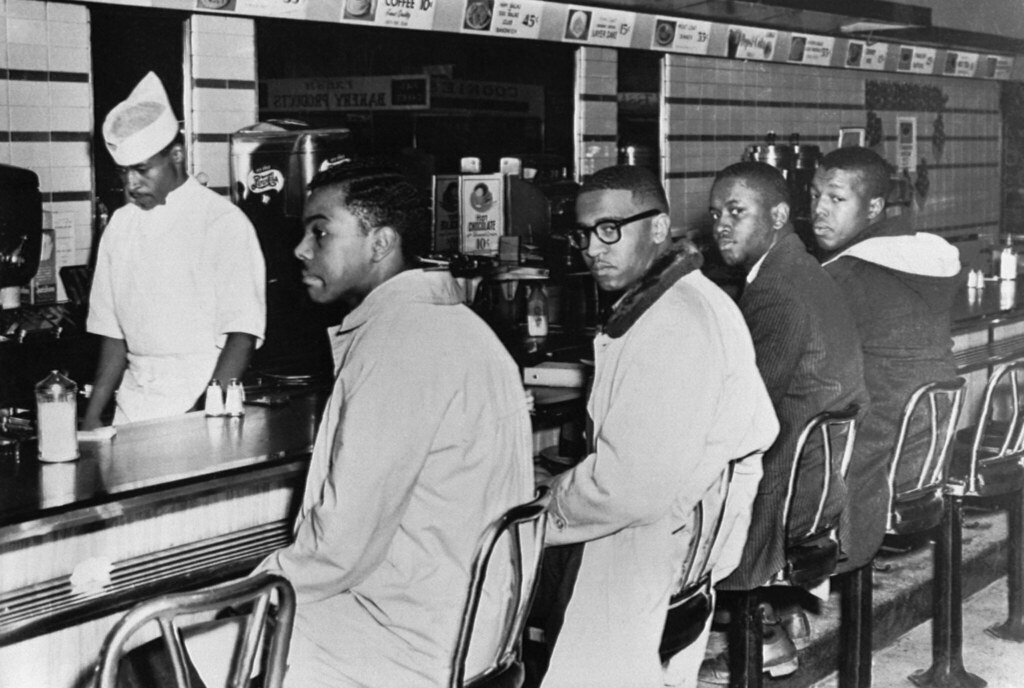
April 29, 2024 marks the 64th anniversary of Austin’s first large-scale lunch counter sit-ins to protest segregated restaurants. The actions were Austin’s entry into a progressive civil rights strategy of passive resistance that began in earnest on February 1 of that year, after a group of African American students sat-in at a Greensboro, North Carolina Woolworth’s counter (History.com Editors, 2022).
Similar demonstrations were staged across the country, resulting in protesters being arrested for trespassing, beaten, and, in some cases, murdered. Their sacrifices led to the re-examination of segregationist service policies and, by extension, a critique of institutional racism in the United States. Hunger served as a pivotal symbol by both mirroring the biological sameness of all human beings and acting as an alarm to signal social inequities.
Food is central to understanding the African diasporic experience in the United States. Culinary historian and James Beard Lifetime Award Winner Jessica B. Harris argues that Texas occupied a complex space for enslaved people in the 19th Century as both a gateway to freedom and as a multicultural intersection. In High on the Hog: A Culinary Journey from Africa to America, Harris notes that enslaved people from Africa were forced into the territory of New Spain by Europeans as early as 1528, cross-culturally shaping the region by synthesizing their traditional recipes with those of Spanish and Native American cuisines (Harris, 2011). These practices continued for nearly three hundred years until enslaved peoples were freed under Mexican independence in 1821. This mélange inspired those who felt marginalized on the East Coast.
The third annual Convention for the Improvement of the Free People of Color (“News from Texas”) was held in Philadelphia, Pennsylvania in 1833. Debate about how to escape from racist oppression led to a vote for mass immigration to Texas (Harris, 2011). From afar, Texas appeared to be a refuge. However, tensions between Tejanos and the Mexican government were on the eve of erupting into another revolution. When Texas became an independent republic in 1836, its government reinstated slavery laws. By 1845 it was annexed to the United States as a slave state. The Civil War broke out shortly thereafter in 1861, leading to a Texan alignment with the Confederacy.
When Major General Gordon Granger of the Union Army ordered the final enslaved Texans freed on June 19, 1865, two years after the Emancipation Proclamation was issued, African American cuisine took on a new importance. Jessica Harris reflects:
[T]he backbone of Juneteenth celebrations had always been the table. In the early years, those who had toiled in sorrow’s kitchen commemorated their liberty with some serious eating. Picnics and barbecues were the hallmarks of the early celebrations, and groaning boards covered with bright cloths offered specialities like barbecued ribs and fried chicken and myriad variations on summer produce like black-eyed peas, peaches, and watermelon (Harris, 2011).
In a society of oppression, sharing food was a subversive act that expressed hard-won freedom.
Laws enforcing segregation at the state and local levels took hold following the Civil War. Reconstruction, the Federal Government’s attempt to rebuild Southern states by creating employment, land cultivation, and political office opportunities for those who were formerly enslaved, fizzled by 1877. President Andrew Johnson, Abraham Lincoln’s successor, and other conservative Southern Democrats stymied progress by calling for the return of land to its original owners and arguing that state governments should be in charge of their own rebuilding (Manevitz, 2020). The resulting “Jim Crow” laws enforced segregationist policies through the division of public spaces like water fountains, movie theaters, and restaurants.
Almost one hundred years later, the Greensboro Four challenged the separation of public spaces in 1960. Ezell Blair Jr., David Richmond, Franklin McCain, and Joseph McNeil, young Black men studying at North Carolina’s Agriculture and Technical College, took seats at their local Woolworth’s lunch counter and asked to be served. The request sent shock waves through America and reinvigorated the civil rights movement. Moreover, it illustrated the power of student voices to challenge a broken system. Protests sprang up across the South, including Texas. San Antonio became the first major Southern city to integrate its lunch counters on March 16, 1960 (“San Antonio Woolworth’s Building,” 2020).
To get ahead of any conflicts in the state’s capitol, a conference was arranged by the Austin Commission on Human Relations and held in a meeting room at the Austin National Bank. African American community leaders from East Austin and a delegation of students met with operators of downtown cafeterias, cafes, and lunch counters. Reverend Brandoch Lovely of the Austin Unitarian Church served as the spokesperson for the community and student leaders. He was quoted in the Austin Statesman on April 20, 1960, saying he hoped for a “‘peaceable adjustment’” (Weddell, Jr., 1960). Lovely went on to say, “‘There is a necessity for both sides to act with responsibility,…Negro students have shown a willingness to negotiate, and I hope the restaurant operators will adopt the same attitude’” (Weddell, Jr., 1960).
Austin Bureau of the News journalist Richard Morehead reported an update on April 29. “Congress Avenue, the capital’s main business district, was picketed Wednesday by students urging integration of lunch counters,” (Morehead, 1960) he noted. “The demonstrators indicated they plan to stage sitdowns by Saturday unless segregation is dropped in downtown eating places” (Morehead, 1960). The threat prompted businesses in major areas like those on the corner of Sixth and Congress to close their soda fountains, fixtures of mid-century drug stores and eateries. Other establishments put chains on their doors and only let in white customers.
Moorehead’s article also revealed that the protesters were multiracial and of mixed genders. “White and Negro students–both male and female–participated in the picketing on both sides of Congress Avenue from Sixth Street to Eleventh, [the] edge of the State Capitol Grounds” (Morehead, 1960). In total, over 200 picketing students came from the University of Texas-Austin, St. Edward’s University, Huston-Tillotson University, and local theological seminaries. Without resolution that day, approximately 100 students occupied seven lunch counters across the aforementioned area, peacefully requesting that Black patrons be served the same as white ones.
Surprisingly, little information exists about the sit-ins in city archives like those of the Briscoe Center for American History at UT-Austin and the Austin History Center. However, a wealth of coverage was devoted to their aftermaths. State legislatures took aim. On March 10, 1961, the Austin Statesman reported on HB 797, a bill making it “unlawful ‘for any person or group of persons’ to enter a privately owned commercial enterprise and remain there after being requested to leave, ‘or after it appears unequivocally that the presence of such person or group of persons is undesirable and unwanted by the owner or management of such enterprise’” (Capitol Staff, 1961). Ironically, the article also specified that the bill’s text noted that “provisions are to be applied ‘without regard whatsoever to race, color, or creed…’” (Capitol Staff, 1961).
Christopher W. Schmidt argues that the nationwide sit-in movement made such an impact because of its innovation. “[Students] were not simply joining a battle that the older generation of civil rights activists were already waging,” (Schmidt, 2017) he writes. “They were striking out on their own, finding new points of vulnerability in the edifice of Jim Crow and locating new targets that resonated with their particular concerns and that aligned with their particular sources of strength” (Schmidt, 2017). Sit-in protesters altered the direction of the movement by putting their bodies on the line to expose the inhumane gesture of denying any person sustenance.
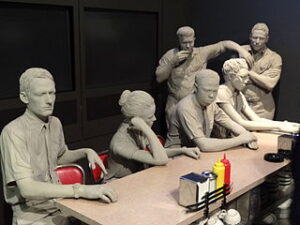
As the sixties wore on, passive resistance faded into more pronounced demonstrations like large-scale marches, Black Power militarism advocated by Stokely Carmichael, and the community service-based activism of the Black Panther Party. Arguably, the Panthers’ greatest interventions were the Free Breakfast for School Children and Free Food Program initiatives started in 1969 (Magoon, 2023).
The former’s aim was to satiate starving children in impoverished neighborhoods so they could concentrate on learning. The latter aimed to serve families and communities that otherwise would go hungry. Black Panther Party activity was relatively quiet in Austin during the group’s original tenure, instead being more concentrated in Texas cities like Houston (Smith, 2016). That changed when the New Black Panther Party for Self Defense, founded in 2001, continued the legacy of food activism. Its Austin chapter made news over that year’s Thanksgiving holiday by distributing turkeys and food baskets to families in need (Apple, 2001).
One recognizable manifestation of the 1960 lunch counter sit-ins in contemporary Austin is the fact that low-income Black and Brown neighborhoods in East Austin are still classified as “food insecure” or “food deserts” (Contreras, 2022). Formal segregation was dismantled, though its residual currents still divide the city.
This April, when eating out in any Austin public space, let’s offer a non-denominational prayer of gratitude for those who made it possible for us to share those meals together. Let’s also keep an open seat at our tables for the next leaders who will feed this hungry legacy.
Works Cited
Jones, A. (2012). Diorama of Lunch Counter Sit-Down Protests – National Civil Rights Museum – Downtown Memphis – Tennessee – USA – 01 [Photograph]. https://commons.wikimedia.org/wiki/File:Diorama_of_Lunch_Counter_Sit-Down_Protests_-_National_Civil_Rights_Museum_-_Downtown_Memphis_-_Tennessee_-_USA_-_01.jpg.
Standing up by sitting down: Student Sit-Ins 1960. (n.d.). https://www.civilrightsmuseum.org/standing-up-by-sitting-down.
[Greensboro Four photograph]. (1960). Public Domain.
https://creativecommons.org/publicdomain/mark/1.0/
[Greensboro Lunch Counter Sit-In photograph]. 1960. African American Odyssey – Library of Congress. https://www.loc.gov/exhibits/odyssey/educate/lunch.html.
Apple, L. (2001). Lone Star Panthers. Austin Chronicle, https://www.austinchronicle.com/news/2001-12-07/83919/.
Capitol Staff. (1960). House Bill Is Aimed at Curtailing Sit-Ins. Austin Statesman.
Contreras, N. E. (2022). Austin Approves Resolution Aimed at Combating Food Insecurity in Food-Insecure Areas. Austin-American Statesman. https://www.statesman.com/story/news/2022/04/21/austin-city-council-resolution-food-insecurity-bus-routes-grocery-stores/7381822001/.
Harris, J. (2011). High on the Hog: A Culinary Journey From Africa to America. Bloomsbury.
History.com Editors. (2022). Greensboro Sit-In. History.com. https://www.history.com/topics/black-history/the-greensboro-sit-in.
Manevitz, A. (2020). Failures of Reconstruction Have Never Been More Evident or Relevant Than Today. Washington Post. https://www.washingtonpost.com/outlook/2020/06/11/failures-
reconstruction-have-never-been-more-evident-or-relevant-than-today/.
Magoon, K. (2023). Revolution in Our Time: The Black Panther Party’s Promise to The People. Candlewick Press.
Morehead, R. M. (1960). “Student Pickets in Austin Ask for Integration.” Austin Bureau of the News.
News From Texas. From the Austin Citizen. Colored Conventions Project. Retrieved March 10, 2024. https://omeka.coloredconventions.org/items/show/1616.
San Antonio Woolworth’s Building 2020. World Monuments Fund. https://www.wmf.org/
project/san-antonio-woolworth-building.
Schmidt, C. W. (2017). Why the 1960 Lunch Counter Sit-Ins Worked: A Case Study of Law and Social Movement Mobilization. Indiana Journal of Law and Social Equality.
https://www.repository.law.indiana.edu/cgi/viewcontent.cgi?article=1065&context=ijlse.
Smith. C. H. (2016). Remembering Houston’s Black Panthers. Houston Chronicle.
https://www.houstonchronicle.com/local/gray-matters/article/The-Black-Panthers-The-original-Black-Lives-6833943.php.
Wray, W. Jr. (1960). Talks Called Here Today to Avert Possible Sit-Ins. Austin Statesman.