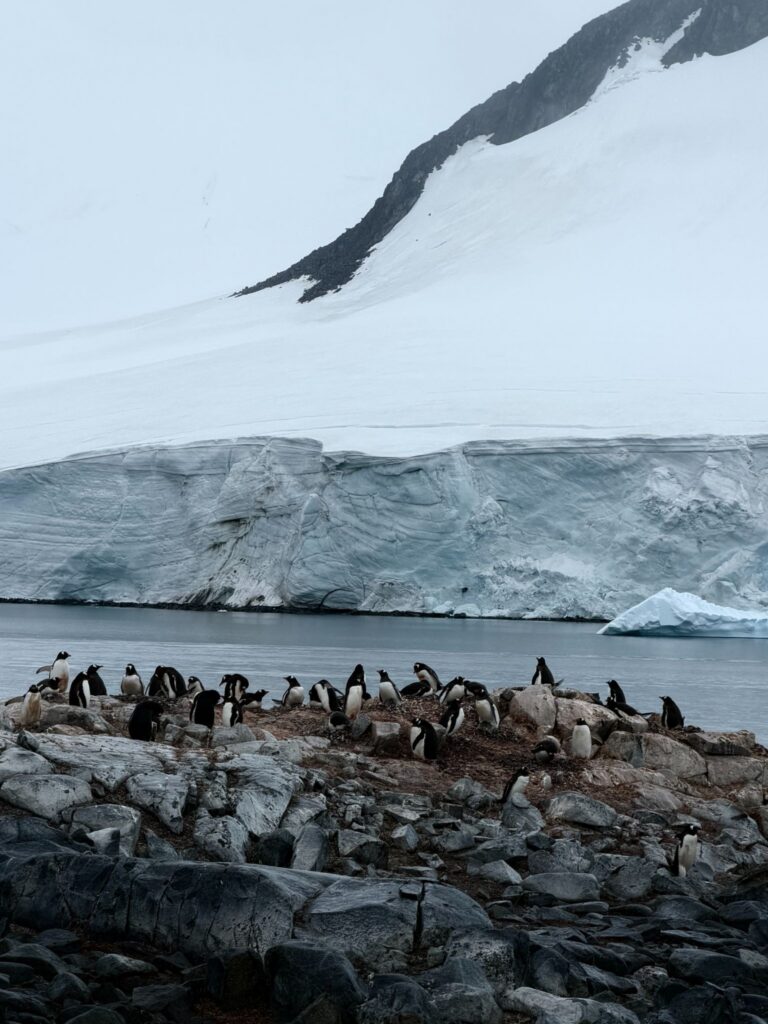
I think of 2026 as my “year of the penguins”. I have had the great good fortune to see penguins on ice in Antarctica and penguins on the beach in South Africa this year. Penguins are fascinating – so awkward on land, and so beautiful in the water. Their “tuxedo” look is distinctive as well as practical, helping protect them from predators.
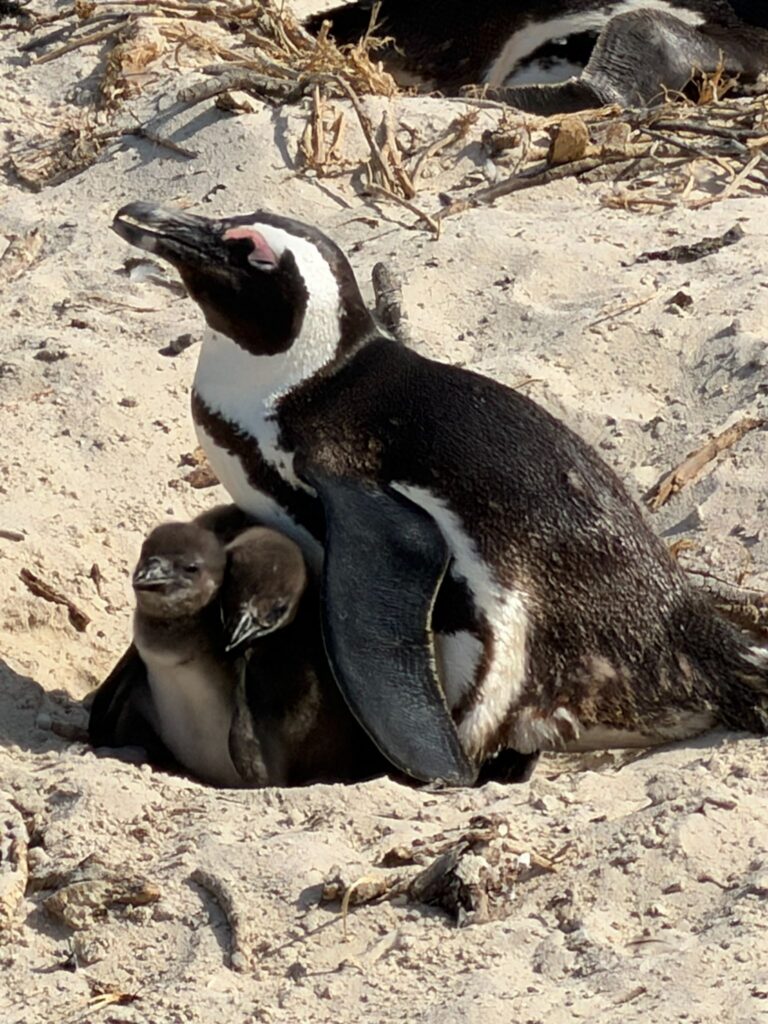
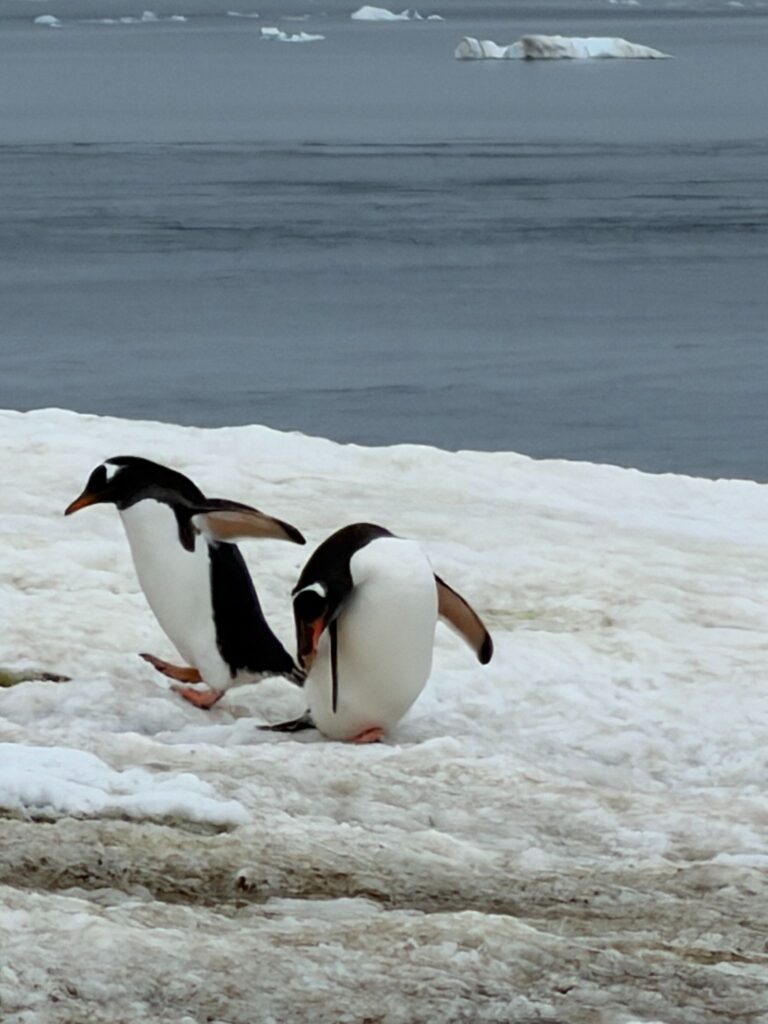
There are so many characteristics of penguins that I find intriguing. They are remarkably talented in the water – they “fly” underwater they’re so fast. They can dive deeply for food. They jump in graceful arcs above the water as they travel or hunt for food. They are very social, living in colonies of hundreds, if not thousands, of other penguins. Living together in colonies helps protect them from predators and provides crucial warmth in Antarctic temperatures. They have a thick layer of blubber, and two dense layers of waterproof feathers. They are monogamous during mating season, and both parents share incubation and care of the chicks. Penguins generally return to the same nesting site each year, and in some species there is a high “reunion” rate of mates year after year.
For me, the most intriguing characteristic of penguins is their catastrophic molt. Over the course of several weeks they lose all of their waterproof feathers and regrow new feathers. This means they “bulk up” tremendously prior to the molt, and during the molt they can’t go in the water. In other words, the place where they are most elegant and at ease is off limits for several weeks each year – they are land bound. They are also fasting during the catastrophic molt, depending entirely on their stored fat.
So how does any of this connect to leadership? I believe in collaborative and inclusive leadership. In other words, I believe in bringing people together to – the sense of penguins – share warmth and defend from predators. We bring people together to connect, collaborate, and co-create our responses to a changing economic and political landscape. Part of my approach to leadership is to build relationships outside the walls of work – lunches, breakfasts, happy hours where we can gather in smaller groups and build stronger bonds. The social aspect of leadership is important to me because it not only makes our work more fun, it makes it more connected.
And what about those habits of monogamy (often finding the same mate year after year) and shared nesting and parenting? There are notions of loyalty and trust and common commitment and responsibility in those penguin habits. As leaders, we must trust those we work with up and down and sideways. And for me as the leader of Academic Affairs at Austin Community College, I support distributed leadership – bringing more people into leadership opportunities so that not only is leadership more widely shared, but the work in Academic Affairs is more collaborative and effective.
You’re wondering about the catastrophic molt and how it relates to leadership, aren’t you? I have both a personal and professional perspective on the catastrophic molt. In my 18 month journey through cancer treatments, I often felt like I was molting, both literally and figuratively. I lost most of my hair, and I lost my eyelashes three separate times. I suffered significant fatigue and lost my stamina, making it impossible for me to commit to work events in the evening or to work the 10 to 11 hours a day that I was used to. I also couldn’t engage with friends socially as much as I wanted. In other words, my “protective exterior” – the way I have long presented myself to the world – disappeared.
I would argue that leadership requires periodic molting. Maybe not catastrophic molting, but molting nonetheless. The way we lead needs to be a constant focus of self-reflection. And self-reflection should help us change or adapt or even reinvent our approach to leadership when circumstances call for it. We should shake off some of our leadership “feathers” and grow some new ones that make sense for the current moment.
Penguins are beautiful and awkward and social and egalitarian and endlessly fascinating. All of us as leaders have moments of beauty and moments of awkwardness in our leadership. We can be social or isolated, broadly inclusive or authoritarian. For me, I choose inclusivity, engagement, and a periodic rethinking of my leadership to reflect the moment. Here’s to the occasional leadership “molt”, and to the impact of collaborative and distributed leadership.