
One of the key throughlines from my time in Johannesburg and Cape Town, South Africa, was the theme of division. Division was an evil and malicious tool that supported minority white rule both before and during apartheid. Division was seen everywhere – tribal divisions, race-based divisions, urban vs. rural divisions, economic divisions, educational divisions, access divisions, political divisions, and the list goes on.
One example of the venality of divisions was seen in Soweto under apartheid. Soweto was and is a very large township in Johannesburg. During apartheid it was divided into different areas for different tribes. Not only did this reflect racial segregation, the government very intentionally located tribes next to each other who had conflicts. In this way, the government stoked inter-tribal conflict so that the oppressed under apartheid would find it harder to band together to work against apartheid rule.
As Nelson Mandela observed in A Long Walk to Freedom, apartheid literally means “apartness”. It was “a monolithic system that was diabolical in its detail, inescapable in its reach, and overwhelming in its power.” South Africa experienced both “grand apartheid” and “petty apartheid”. Petty apartheid focused on segregation by race in parks, theaters, libraries, restaurants, buses. Grand apartheid was focused on systemic, legalistic, and geographic racism (land rights, political suppression, removal from urban centers.). It included stripping Black Africans (or Bantus) of their citizenship (they were only citizens of their tribal homelands) so that they could not claim a right to representation in governing of the nation.
The Apartheid Museum illustrates so many appalling elements of apartheid. Here are two signs from apartheid hanging in the entrance to the museum illustrated division:
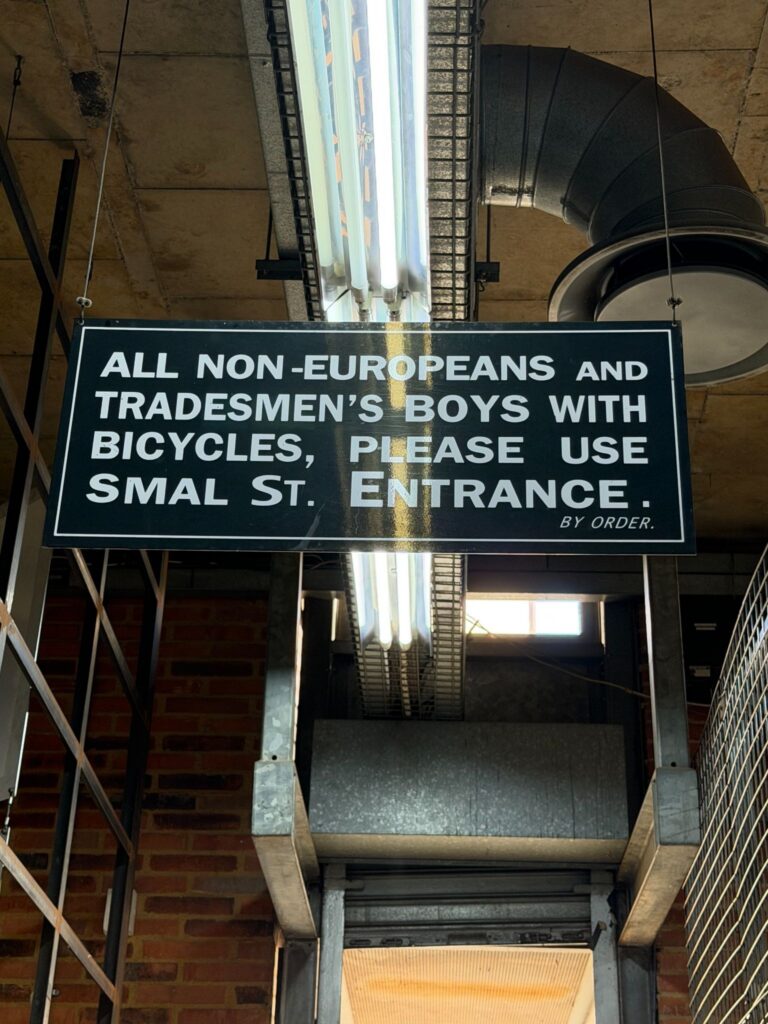
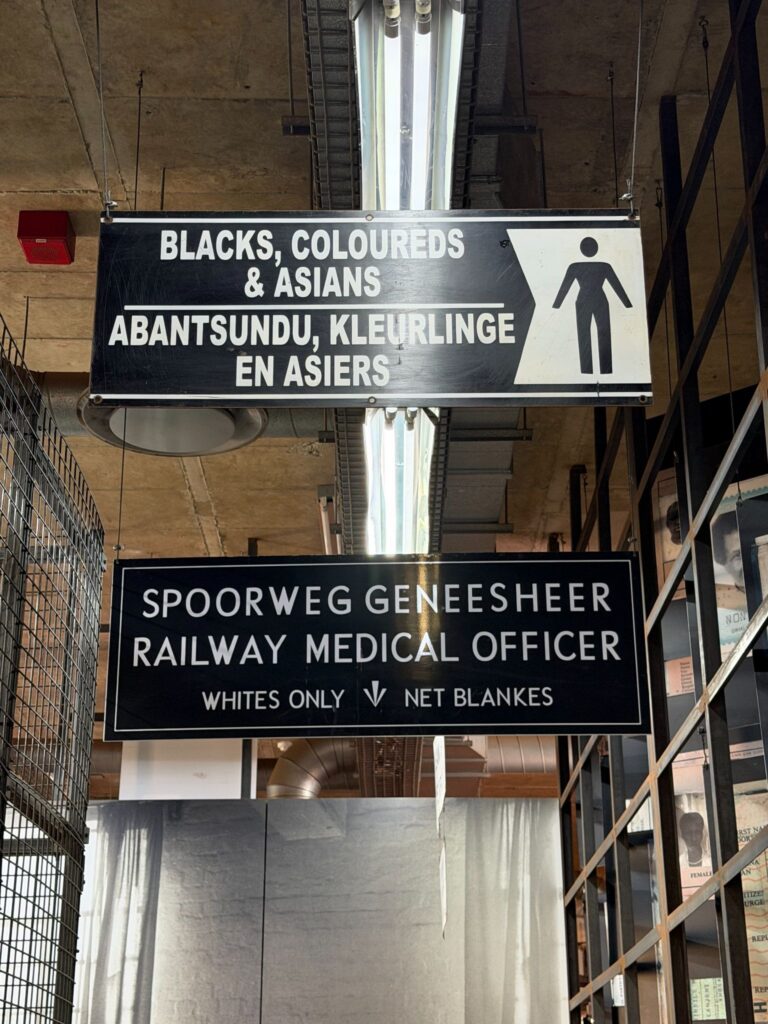
Division was everywhere – at every storefront, on every street, and sometimes in family homes. We were told that at one point the government had a pseudo-scientific “pencil test” to determine who was Black and who was “Colored” (the South African term for mixed race). If a pencil could stay in someone’s hair, they were classified as Black. If it fell out, they were classified as White or mixed race – and those classifications impacted not only family dynamics (if different members of the family were classified differently), they impacted every aspect of someone’s life and future.
I am writing about this singular and malicious and – as Mandela said – diabolical focus on separating people, because it resonates with the world we live in today. Everywhere we turn we can see an emphasis on division – we see leaders and neighbors stoking division, we see people “othering” those who look different or think differently, we see intentional extremism as a means of dividing people, we see divisions by geography and religion and race and language and place of birth and economic status – and I could keep going. We have lost the thread of common values, the social good, and agreed-upon principles.
As I lead in the community college setting, I am reminded to pay careful attention to the ways that we intentionally and unintentionally divide people. We might intend something good when we divide students based on “college readiness”. We might intend something good when we think in terms of adjunct faculty and full-time faculty. We might intend something good when we think “we” (or “they”) own a process or a responsibility or an interaction. But in the community college setting, we are they and they are we. In the community college setting, we are all, as our Chancellor says, helpers and teachers. In the community college setting, we serve all students who walk through our doors. In the community college setting, we all contribute to the betterment of our Central Texas community.
All praise to union, accord, connection, and common cause. May we never intentionally (or unintentionally) seek to divide and conquer. May we always focus on the community college mission that unifies and harmonizes and binds us together.