
I struggle to find the words to describe Robben Island. If it doesn’t sound familiar, Robben Island is in Table Bay, a few miles off Cape Town, South Africa. It has a centuries-long history as a penal colony, and from the mid-1840s to the 1930s it also housed what was known as a leper colony.
Robben Island is most well-known for its more recent terrible history (the 1960s to the early 1990s) of serving as a maximum security prison for political prisoners who fought to bring down apartheid. Its most famous political prisoner was Nelson Mandela, who spent 18 of his 27 years in prison at Robben Island, where prisoners were forced to do hard labor in nearby quarries.
Touring the stark and sobering maximum security prison – and being led on that tour by a former political prisoner on the island – was painful and distressing. But it was also a reminder of the power of the human spirit not just to survive, but in important ways to thrive in the midst of appalling treatment.
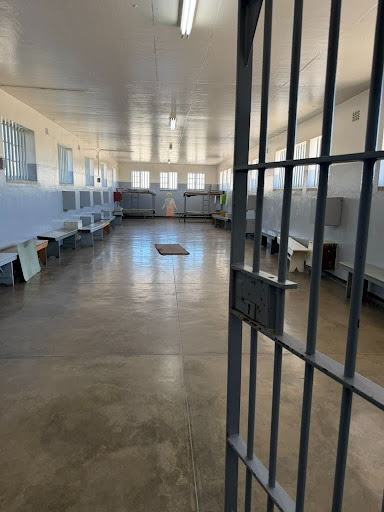
Most prisoners were housed in groups of 60 in a long, narrow room as pictured here.
Black political prisoners (“Bantus”) were given less – and different food – and provided only shorts and shirts, while non-black political prisoners were fed better and received pants and a jacket. For instance, non-black prisoners received 6 oz of meat daily while black political prisoners received 5 oz.
Non-black political prisoners received bread with lunch and supper while black political prisoners did not. Non-black political prisoners received jam or syrup, while black political prisoners did not. The pettiness and meanness of apartheid was apparent on Robben Island.
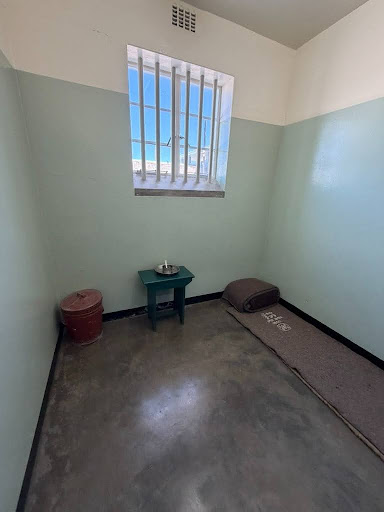
The most well-known leaders of the African National Congress who were imprisoned on Robben Island were housed in individual tiny cells (roughly 7 by 9 feet) with concrete floors, no glass in the windows (just bars), and only a thin mat to sleep on. This is a picture of Mandela’s cell.
In reading Mandela’s Long Walk to Freedom, I was reminded that leadership can occur in any setting, and that leadership can have a positive impact in any setting.
Mandela was a leader throughout his life, and that includes his 18 years on Robben Island, where he led from his tiny cell and where he led in the midst of hard physical labor in the quarries every day.
He helped agitate for better clothing and better food.
He helped develop an education system among the prisoners where inmates taught each other.
He helped cultivate resilience among the prisoners, and patience for the long struggle.
He led the establishment of a code of conduct for the political prisoners, on the basis of which they supported petitions, strikes, and unity in their resistance to apartheid and its consequences.
He engaged with the prison guards through conversation and education in an effort to shift their perspectives.
He mentored other prisoners, and he insisted on integrity in his – and their – commitment to the political principles that guided his decades of leadership in the struggle.
The leadership lesson I take from Robben Island is that thoughtful and intentional leadership is invaluable. Thoughtful, intentional, committed leadership can change lives for the better, it can change a harsh island prison, it can change a country. Robben Island helped me understand that what I do matters, even though my leadership is in a very different context. We all lead and we can all change lives for the better.