
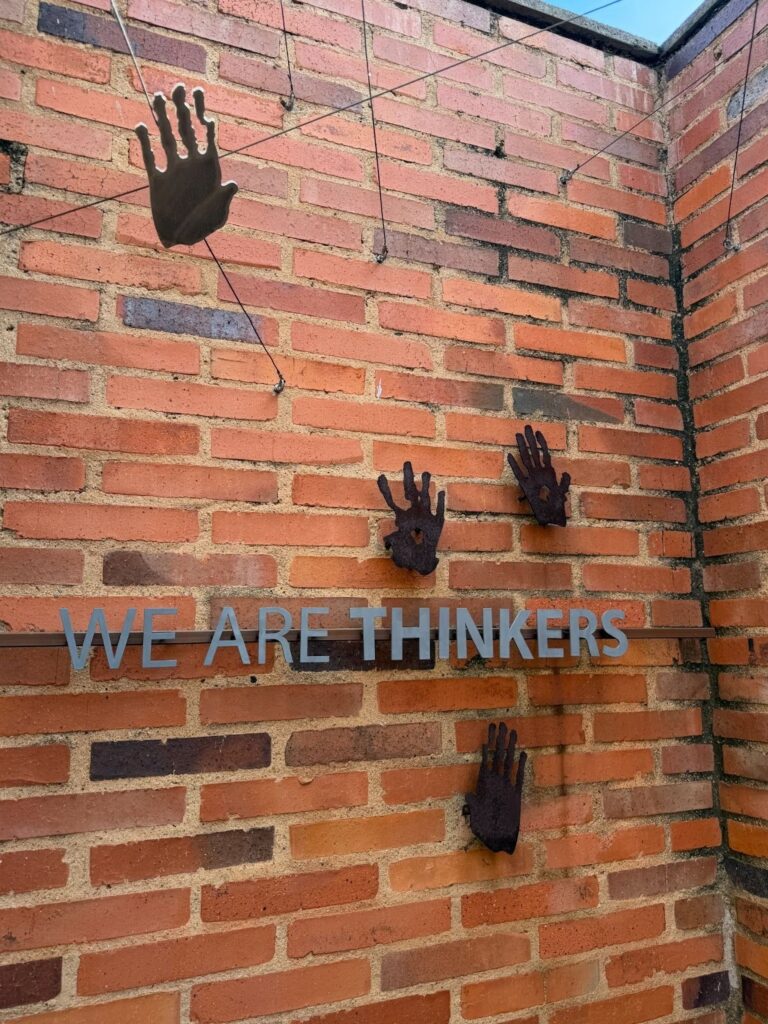
Having arrived home from South Africa on April 11, I have taken some time to try to process our experiences in Johannesburg and Cape Town. One of the most difficult, distressing, and uplifting museums that we visited in Johannesburg was the Apartheid Museum. When you enter you are given a ticket that randomly classifies you as either “white” or “non-white”, and that ticket determines which door you use to enter the museum. One of the first spaces you encounter is the Rock Art Enclosures. It is here that you see and feel the history of South Africa in six descriptors: walkers, thinkers, fighters, gazers, storytellers, survivors.
- We are walkers.
- We are thinkers.
- We are fighters.
- We are gazers.
- We are storytellers.
- We are survivors.
In South Africa I saw walkers everywhere. The public transportation system is almost non-existent, and people walk – along streets, along highways, across busy thoroughfares, around their neighborhoods. They walk with patience and fortitude and practical intent and, most importantly, pride – you can see it in every step they take.
In South Africa I heard from brilliant thinkers who offered their wisdom based on harsh experiences with apartheid and challenging experiences in the post-apartheid world where division is still prevalent and stratification is still evident everywhere you turn. In the face of such experiences they are thinkers – they reflect, they assess, they strategize, they offer insights and perspectives that we can all learn from.
In South Africa I heard from fighters. South Africa is rich in natural resources, and abundance can lead to conflict even without racism and an appalling state-sanctioned system of segregation and oppression. The 20th century history of South Africa is one of fighting for basic human rights and human dignity in the face of an evil and extensive system of apartheid. The South Africa of the 21st century continues to struggle with governance, equality, and care for all the people. One of our speakers noted that South Africa is a country of protest – they are fighters.
In South Africa I developed a deep appreciation for gazers. The landscape is spectacular – Table Mountain, Pilanesburg National Park, Boulders Beach, even Robben Island. Everywhere you turn there is something to look at intently, something to look at curiously, something to look at in wonder. And often something – like the shantytowns in Cape Town – to look at with distress.
In South Africa I heard from so many storytellers. I heard the story of District 6 in Cape Town from Joe who lived it. District 6 was a thriving, vibrant, multi-cultural, diverse part of town at the foot of Table Mountain that was bulldozed, with forced removals of the population to Cape Flats (under the Group Areas Act of 1966) so that District 6 could be a “white-only” neighborhood. I heard from Antoinette, who was 16 in Soweto during the 1976 Uprising, and whose 13 year old brother was shot and killed. I heard from Alan who recently retired from the ministry after 33 years of service in Cape Town actively fighting the disparities that apartheid wrought.
In South Africa I saw survivors everywhere I looked. I saw joy in the face of struggle, I heard glorious music in the midst of inequities, I felt the power of perseverance and commitment to a better world.
May we all learn from the walkers, thinkers, fighters, gazers, storytellers, and survivors of South Africa.